FireModel-AI
Scientific machine learning and reduced-order modeling framework
for fast approximation of complex dynamical systems,
high-dimensional numerical simulations,
and parameter-dependent physical processes.
Scientific Machine Learning Framework
FireModel-AI combines data-driven surrogate modeling,
reduced-order modeling,
and machine learning techniques
to accelerate the approximation and reconstruction
of computationally expensive numerical simulations.
Reduced-Order Modeling
Projection-based and latent-space reduction techniques
for compact representation of high-dimensional systems.
Machine Learning
Data-driven surrogate models for fast approximation
of parameter-dependent dynamical responses.
Scientific Computing
Designed for integration with large-scale numerical simulations
and computational workflows.
Near Real-Time Evaluation
Rapid prediction and reconstruction capabilities
for complex transient systems.
Model Families and Mathematical Concepts
FireModel-AI is designed as a flexible scientific machine learning framework
that can conceptually integrate different model families for reduction,
approximation, signal analysis, and feature extraction.
Autoencoder
Nonlinear dimensionality reduction using encoder-decoder mappings.
z = E(x), x̂ = D(z)
Artificial Neural Network
Data-driven approximation of nonlinear parameter-to-response mappings.
y = fθ(p)
FRF Analysis
Frequency response representation between input and output signals.
H(ω) = Y(ω) / X(ω)
FFT
Spectral decomposition of transient signals into frequency-domain components.
Xk = Σ xn e-i2πkn/N
Convolutional Neural Network
Feature extraction from spatial or structured simulation fields.
y = σ(W * x + b)
Reduced-Order Model
Projection of high-dimensional states onto a compact reduced basis.
x̂ = Urapred
Applications
The framework can be adapted to a broad range of scientific
and engineering problems involving complex dynamical behavior
and computationally intensive simulations.
-
High-dimensional transient simulations
-
Parameter-dependent surrogate modeling
-
Reduced-order approximation of physical systems
-
Fast reconstruction of numerical simulation outputs
-
Data-driven scientific computing workflows
-
AI-assisted engineering analysis
Reduced-Order Modeling Concept
A high-dimensional system response can be approximated
within a reduced latent representation:
Mathematical formulation
x̂ = Urapred
The dominant structures of the original system
are represented in a low-dimensional basis.
A surrogate model estimates the reduced coefficients,
allowing rapid reconstruction of the system response
while preserving the dominant physical behavior.
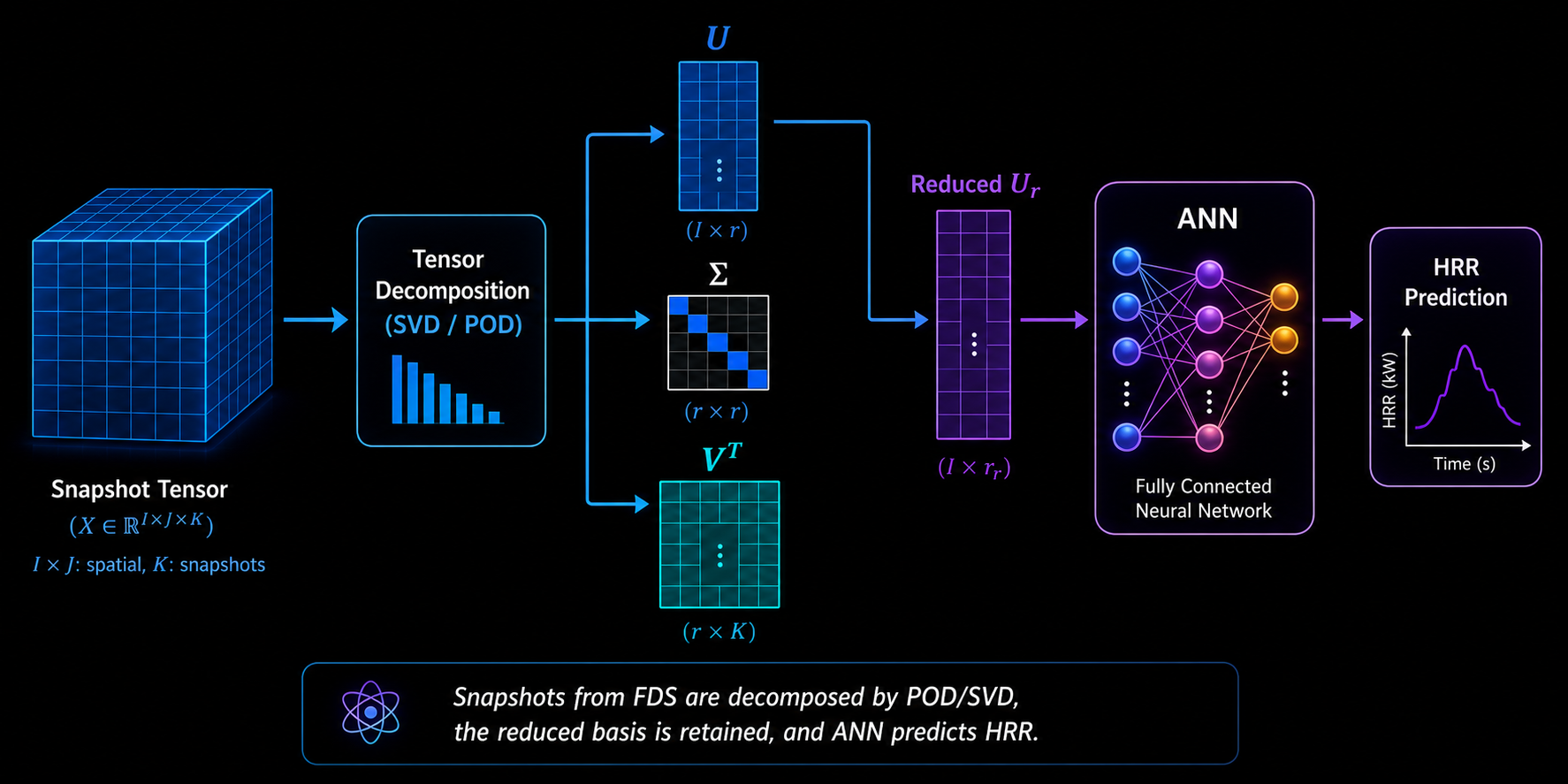
Illustration of a generic reduced-order modeling workflow.
Research and Development
Developed by
Mehrdad Nouroozyan
within ongoing research activities
in scientific machine learning,
reduced-order modeling,
computational modeling,
and data-driven engineering analysis.
The framework focuses on bridging
high-fidelity numerical simulation workflows
with efficient machine learning approximations
for scalable scientific computing applications.